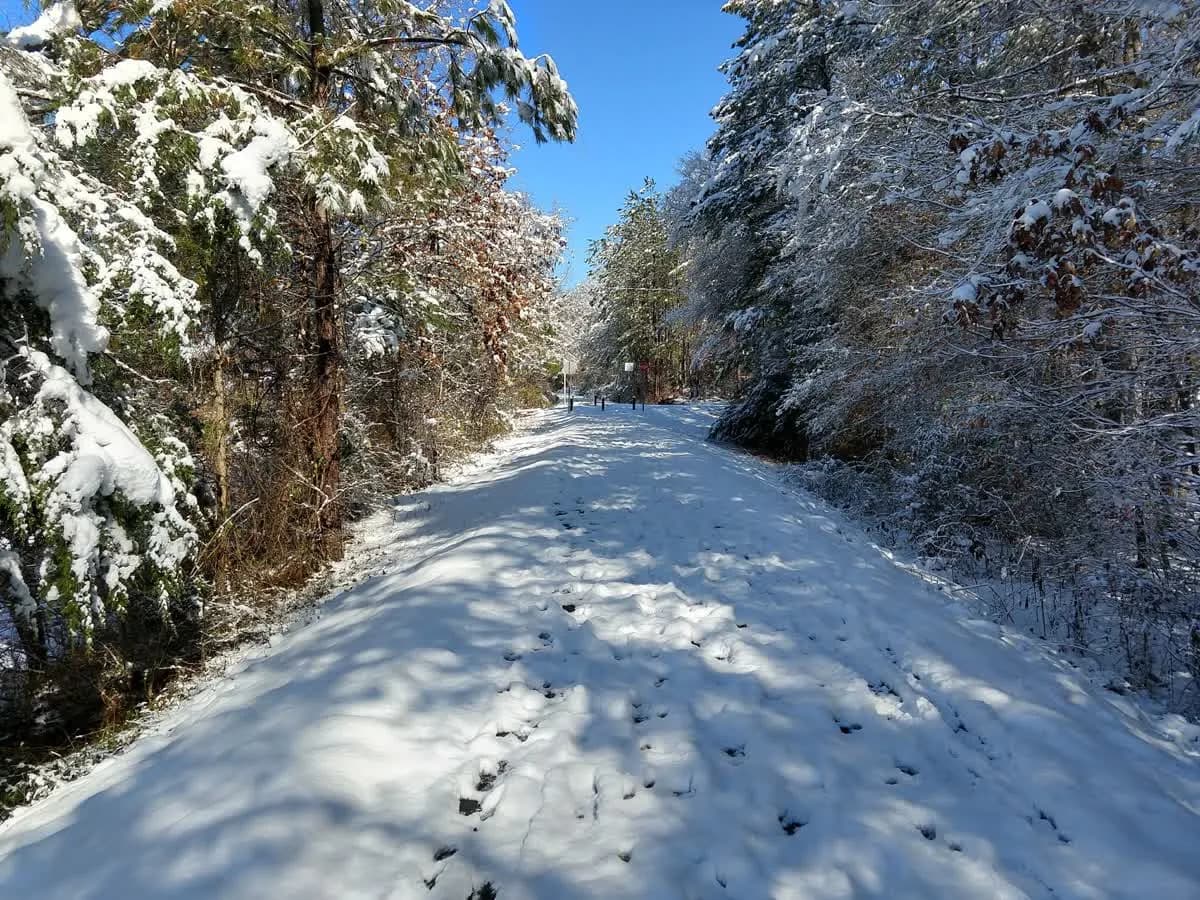
We'd ride our bikes half a mile north to Cedar Springs Creek and swim — July, August, September. The kids would look for snails, watch fish in the afternoon shade, play under the trail's own pedestrian bridge over the creek. Occasionally someone homeless was under there too. That creek was helping ease my depression. I have pictures of the kids there — good ones.
I used to call it "la-dee-ga." I didn't know how else to say it.
My first time on the trail was in college. It ran right through the Jacksonville State University campus, crossed Highway 204, and I had an apartment that joined it. I walked and ran it up toward Piedmont and back.
Heather and I walked it when we were dating — that's partly how I got to know her outside of the classroom.

Heather on the trail. c. 2008.
When I came back to Alabama, I was appointed as pastor at Weaver First United Methodist Church. The trail runs right through Weaver. The parsonage was an eighth of a mile from it. I lived there six and a half years.
I ran four, five miles on it a couple times a week — wrote sermons on it, brainstormed with Heather, played at Weaver Elwell Park. I'd take breaks from work just to go. We had church members who lived along it that we'd see as we passed.
I cried a lot on that trail, as I remember.
I'd ride a few miles north to the old Jacksonville train station — renovated around 2017, turned into a community center. I'd listen to a sermon podcast, a brainwave session, get myself ready to write. Then I'd sit outside on the bench or at the picnic tables by the creek on the trail spur, in the shade of the trees. Cyclists and runners passed. JSU students hung in hammocks just south of the Greek Row the trail bisects.

The old Jacksonville train station. The marker mentions Chief Ladiga. 2019.
Once a month I'd ride further — all the way to Germania Springs Park, just north of campus. I'd string my hammock up in the mulberry trees near the creek. Journal, pray, plan sermon series. A whole day.
We taught all four kids to ride their bikes there. The kids called the section south of Elwell Park the tree tunnel — that stretch toward Michael Tucker Park where the canopy closes over you. We pushed the twins in the double stroller through it. I ran the Woodstock 5K with them in that stroller — their little cheeks would bounce, and people would smile when we passed.

Weaver, AL. October 2017.
It was around 7:30, summer, still cool, dew on everything and morning mist on the trail. Pink mimosa blooms hung over the path. I was running the section north of the Weaver Lane crossing. Noah rode beside me on his little bike — five, maybe six years old.
He noticed the trash on the side of the trail.
"Why do people leave trash?" he asked.
"Because they're broken," I said.
"Because they're broken."
We moved to the farm in April 2021. I was excited because it was right there on the trail, right behind Walmart. The extension south of Michael Tucker Park had been promised for years — I'd downloaded the PDF from the Anniston City plans, tracked the project. When they finally broke ground, we could watch the clearing from the property. We walked across the railroad bed to get to Walmart. People camped out there. There were homeless people living on that stretch before it was anything.
When it was just big gravel chunks I ran it anyway. Technically trespassing. I'd run up to the McClellan spur and back, passing homeless people who lived under the bridges near our house. It was raining hard the day of the grand opening. Everyone moved inside Coldwater Mountain Brew Pub — reporters, council members, cameras — while Ciara Smith gave the speech. She was vice mayor then, standing in for Toby Bennington, who'd been in a car accident and couldn't be there. Toby had been the spear on this project for fifteen years. I livestreamed it on Facebook. When the rain let up they went back outside and cut the ribbon. Four million dollars: brush clearing, bridge rebuilding, the whole corridor.
Once the trail was paved, we'd ride our bikes half a mile north to Cedar Springs Creek and swim.
Patrick Wigley was fielding the public version of the same problem — the homeless corridor, the dogs — at ARC meetings and NEABA meetings, talking to reporters. I was living it from the farm side.
More often it was ice cream and beer runs — Sunday nights, Sabbath eve, crossing the trail with the kids, my headlamp lighting the way to Walmart. Pastors work Sundays. Our Sabbath was Monday. Sunday night was the crossing.
It was around eight in the morning, June, already muggy. Red clay on my shirt, privet pressing in on both sides, the lumber from the Hindman deck demolition stacked beside me. I was thirty feet from the trail, post hole digger in my hands, ratchet straps rigged up to lift the power pole, when Mayor Ciara Smith and Patrick rode up and stopped.
"Hey Matt!" she called.
They asked what I was doing. I asked what they were doing.
"Patrick is giving me a tour," she said.
Patrick looked over at the pasture. "It's looking good — you guys are cleaning it up."
A few months earlier I'd been out there flail mowing. We'd been harvesting peonies too — they'd hit their third-year prime, the ones we'd planted back in 2022.
Sarah Woolmaker — Assistant Director at Anniston Museums and Gardens — had been buying Heather's flowers at the farmers market every Saturday. She already knew us.
I walked her and Audrey Maxwell — Tourism Director for the Calhoun County Chamber of Commerce — through the house — the dog run structure, the farm history, the prohibition-era speakeasy from the McClellan days that was now my children's bedroom: a large room with heart pine floors and ceiling, big windows, bunkbeds, toys scattered everywhere. Then out to the backyard, beside the back porch.

The high tunnel.
I cut snapdragons from the high tunnel with my pocketknife and gave them to Sarah and Audrey.
Sarah is a flower lover.
Standing there, we both got excited and started talking fast. Sarah was matching my energy — we kept interrupting each other, both talking at once, both lit up. She was very interested in the interpretive signage idea, the 1832 connection, the bicentennial.
Before the ribbon cutting, there were camping tents, mattresses, and mirrors on our property adjacent to the trail. One morning I watched a man hitting rocks with a baseball bat next to our trail shop. There was a persistent guy I started calling the sheep creep — he'd keep showing up from the trail to admire our sheep and let his dog chase them all over the place. A pack of dogs attacked them once in early 2025. The sheep creep let them out of their netting while they were grazing near the trail. I found them wandered back up into the backyard.

January 2025.
I ran it while I was manic. I had whole conversations on that trail — starting at sunrise, hours through the day, walking north and south back and forth, talking into my phone. I was trying to think my way out of something you can't think your way out of. The mimosa blooms were there the whole time.
Around November 2024, I was meeting my dad weekly to ride the trail north from Michael Tucker Park — a two-minute drive from the farm, early in the morning. Him on his recumbent, me on the 80s Peugeot my father-in-law had given me. We'd talk about my recovery.

The Peugeot. Michael Tucker Park. September 2024.
Once, near the end, I walked from downtown Anniston all the way back to the farm — about four miles, in my farm boots, depressed. The trail south of our property had just been finished. It was the first and only time I saw the whole thing completed.
I tried to build a bridge across the trail.
I'd contacted Mayor Ciara Smith and Toby Bennington in the first place to get a power line authorized to run electricity from the Walmart parking lot pole, behind Tractor Supply, across the trail to the farm. That was the reason for all of it. Alabama Power cut down a tree on the city's property alongside the trail to clear the way. The pole went in. Got connected.
I never turned it on. By the time they were installing it, I was up the hill in my bedroom. Late September 2025. Hiding from the world. The depression before the hospitalization.
While I was working the power line, I'd also tried to build a bridge. I met with Toby and with the city engineer Branton to get permission to connect the farm to the trail directly. I'd gotten lumber from a deck demolition Preston and I did in July at Mike Hindman's house — piled it right next to the trail shop site on some spare pallets. But Branton held off on the permit and the city never said yes. The lumber sat there, eventually overgrown with weeds, until the house sold.
I was in the hospital by then. Ross hauled it off for Heather along with the last of our stuff — Ross Junk Removal, a guy I'd met at the Sinclair Social a few blocks from the trail in downtown Anniston, drinking beers one evening while we sold bouquets out of the Bloom Bar. The bridge that never was. The power pole that was never turned on.
I met with Toby at City Hall. Toby and Branton were both there. I sat in Toby's office and shared my manic visions with him — or I was just coming off the mania by then, starting to see the beginning of the end, but I wouldn't have known it yet. Toby talked to me for a long time. He was interested in the bicentennial idea. At some point he held up the color printout of the Ladiga Trail Porch — the document I'd brought — and asked, "Can I keep this?"
Toby praised me for my cooperativeness and patience with the movement on the project. Branton explained that they'd need to draft a policy document about trail crossings — with a lawyer's help. Nobody had made a request like mine before. I would be the first.
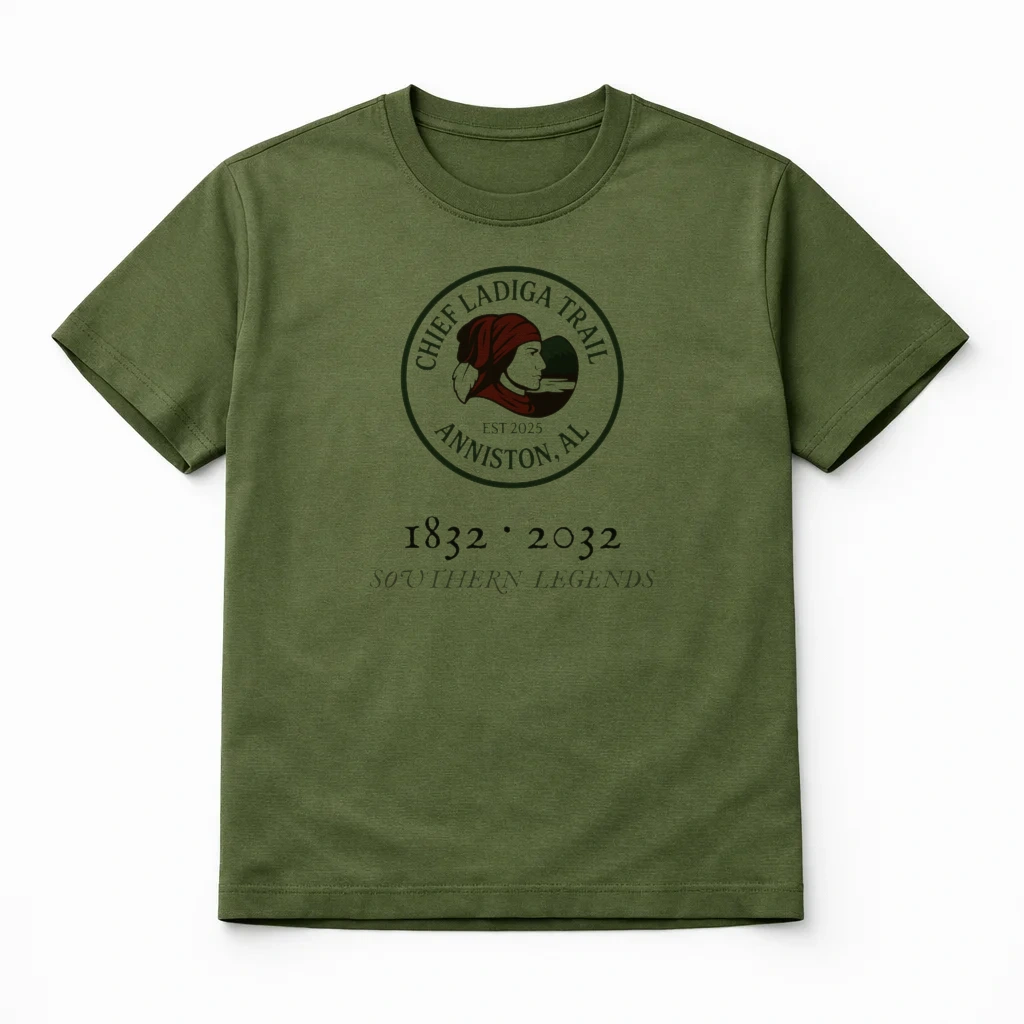
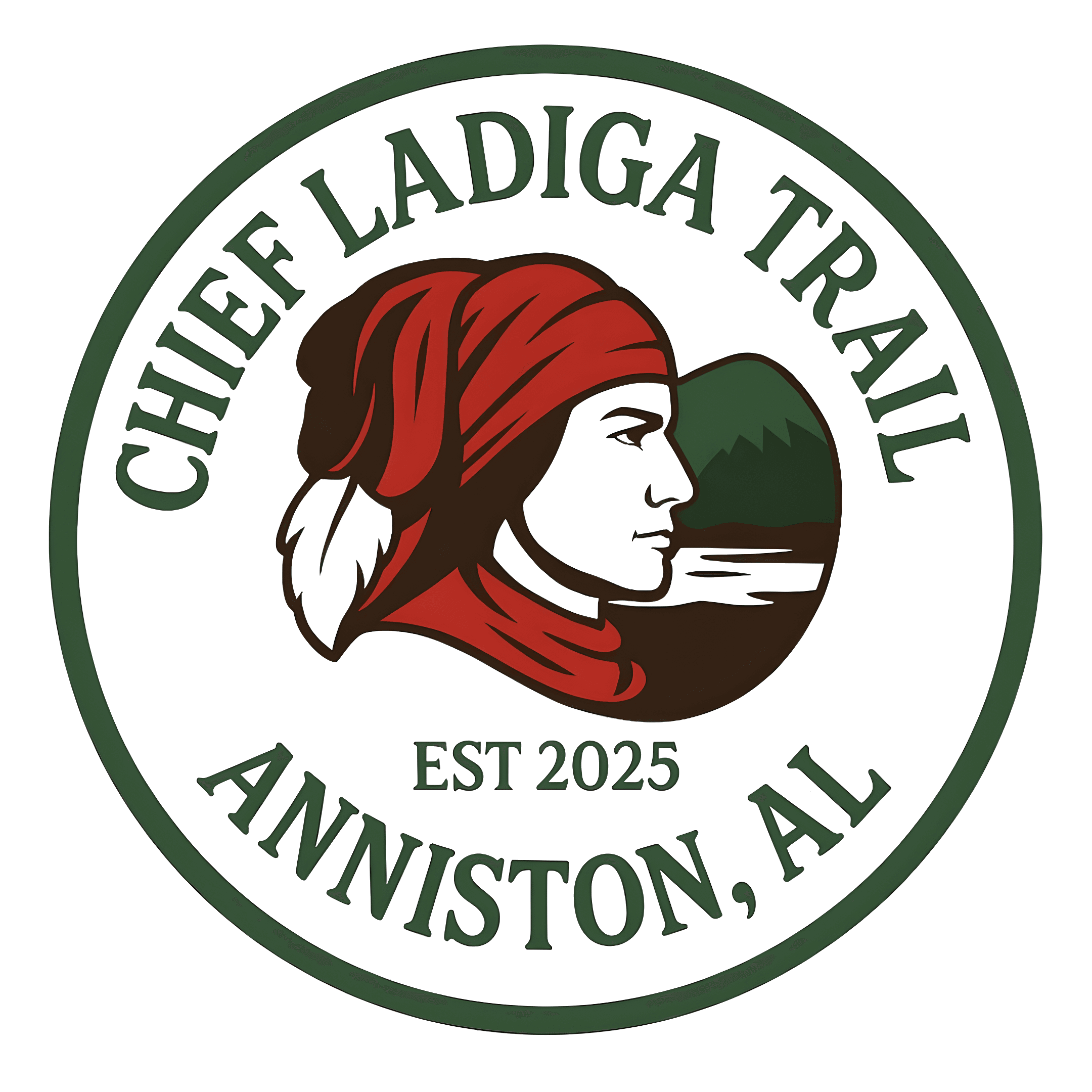
I think the trail's name both honors Chief Ladiga and uses him. The official logo for the Anniston extension has a Creek man on it. I designed a shirt with that same figure on it.
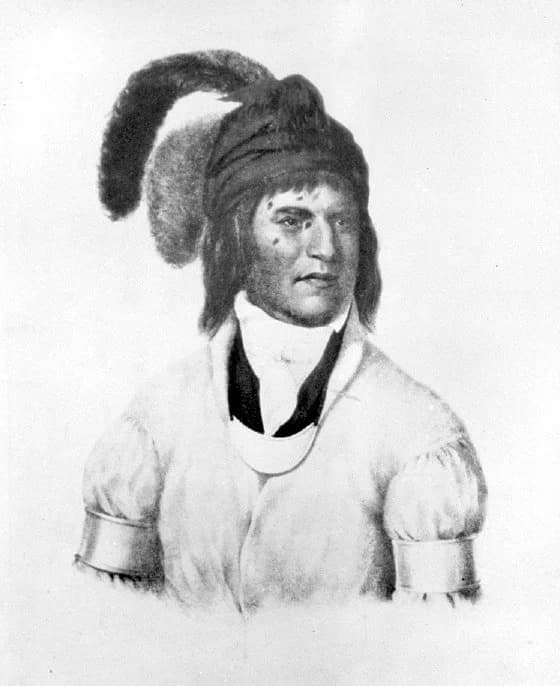
What I know is this: Chief Ladiga signed away his people's land in 1832. His people, the Muscogee Creek, were removed. The railroad was built on that corridor. The railroad was abandoned. And now there's a trail named after him.
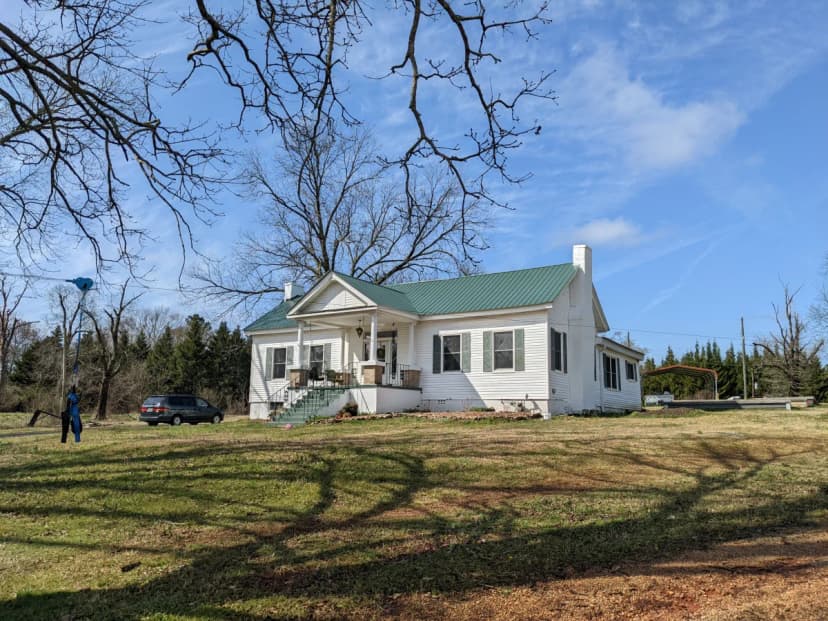
5400 Ridgewood Ave. February 2022.
The farmhouse we lived in was built in 1832. The same year. We had a copy of the deed. I remember being blown away when I made that connection — the same year Chief Ladiga signed the treaty, someone built the house I was living in.
What I didn't know then: Jacksonville, the town where I first ran that trail, was founded on land Ladiga personally owned and sold in 1833. Two thousand dollars to a speculator named Charles White Peters. That land became the town. JSU sits on it. I was running Ladiga's land before I knew his name.
"Running on someone else's land."
The trail ends in Piedmont at a shop called Chief Ladiga Trading Post — fudge, ice cream, and firearms.
During the manic episode, I had an idea for a campaign — a multi-year effort building toward the 200th anniversary of the treaty. The city of Anniston, the Muskogee Creek Nation, Rails to Trails, the farm. All of it connected. I pitched it to a t-shirt printer at the Jacksonville Farmers Market. I felt like I was seeing something true.
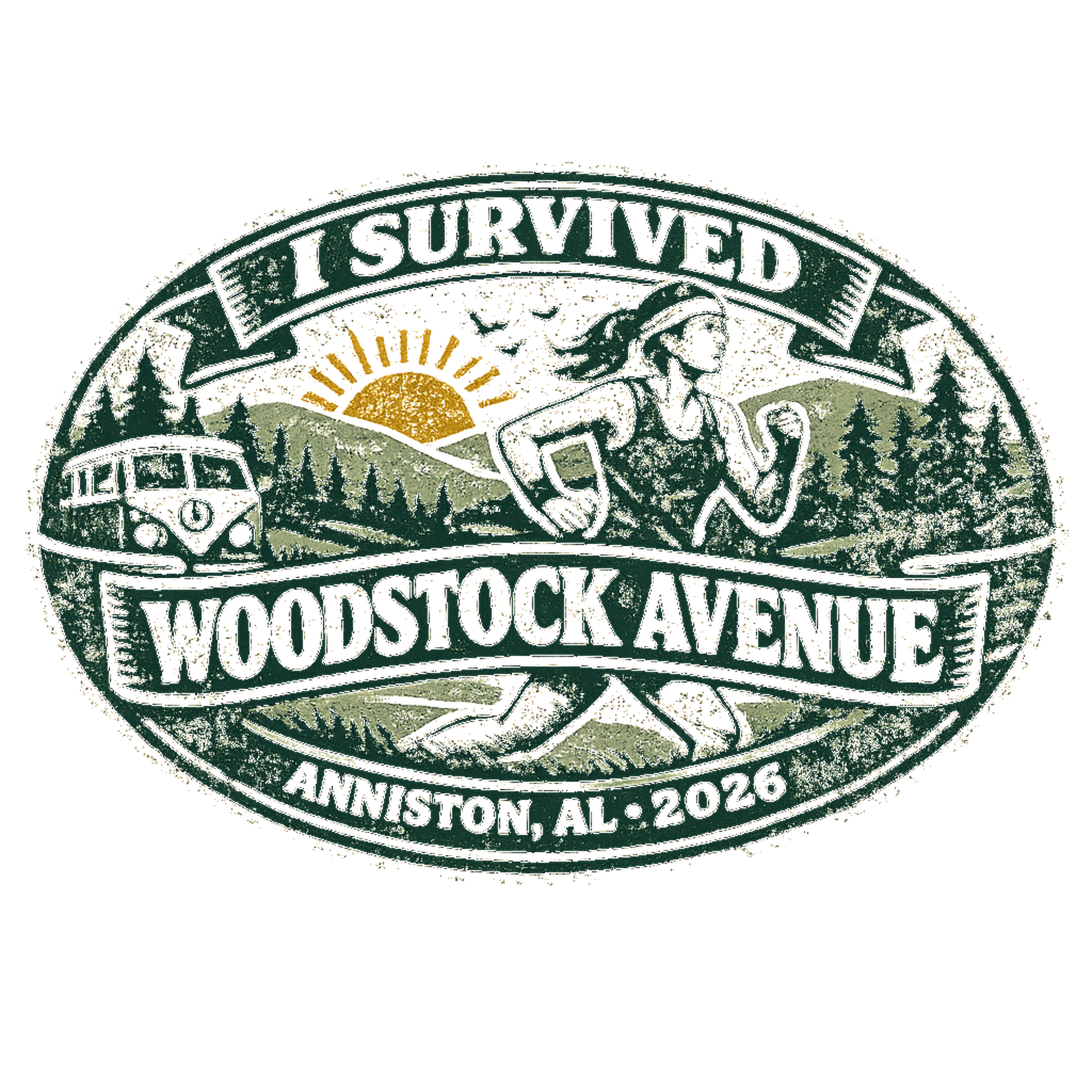
It came back this week. I was designing a t-shirt. I started writing about the trail.
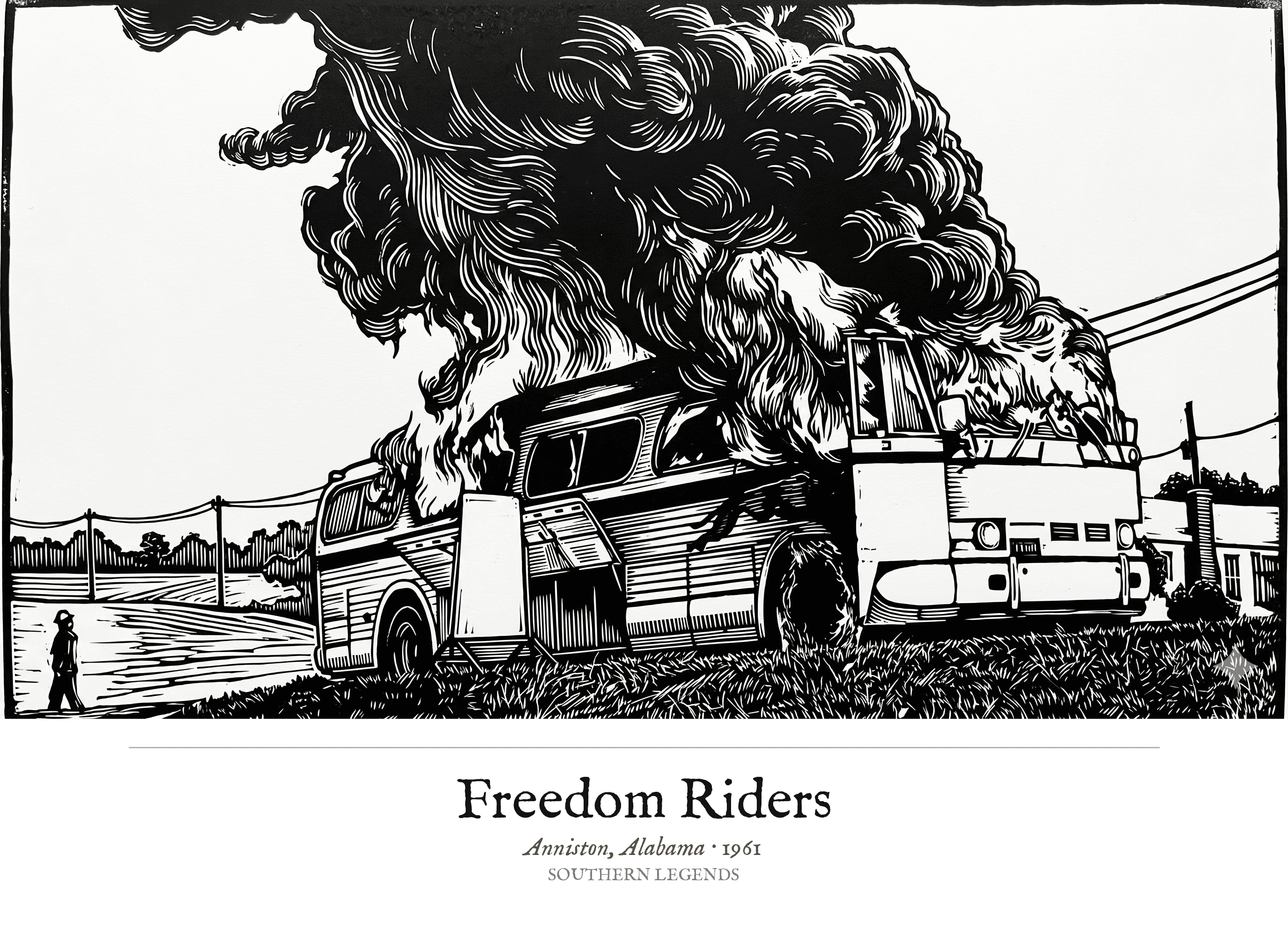
2032 is six years away. I'd reach out to the Muskogee Creek people and take their lead — collaborate with the city, use Southern Legends as part of where the story lives.
These are ideas I had when I was manic. I'm not sure they're dead.
The trail crossing on 204 is ten minutes from where I live now. I haven't gone back yet. It's a sore memory.
But Soren has been walking it with his friend. They live in an apartment south of the university coliseum, a few hundred yards east of the trail. He doesn't know all of this yet. Maybe he will.




Responses