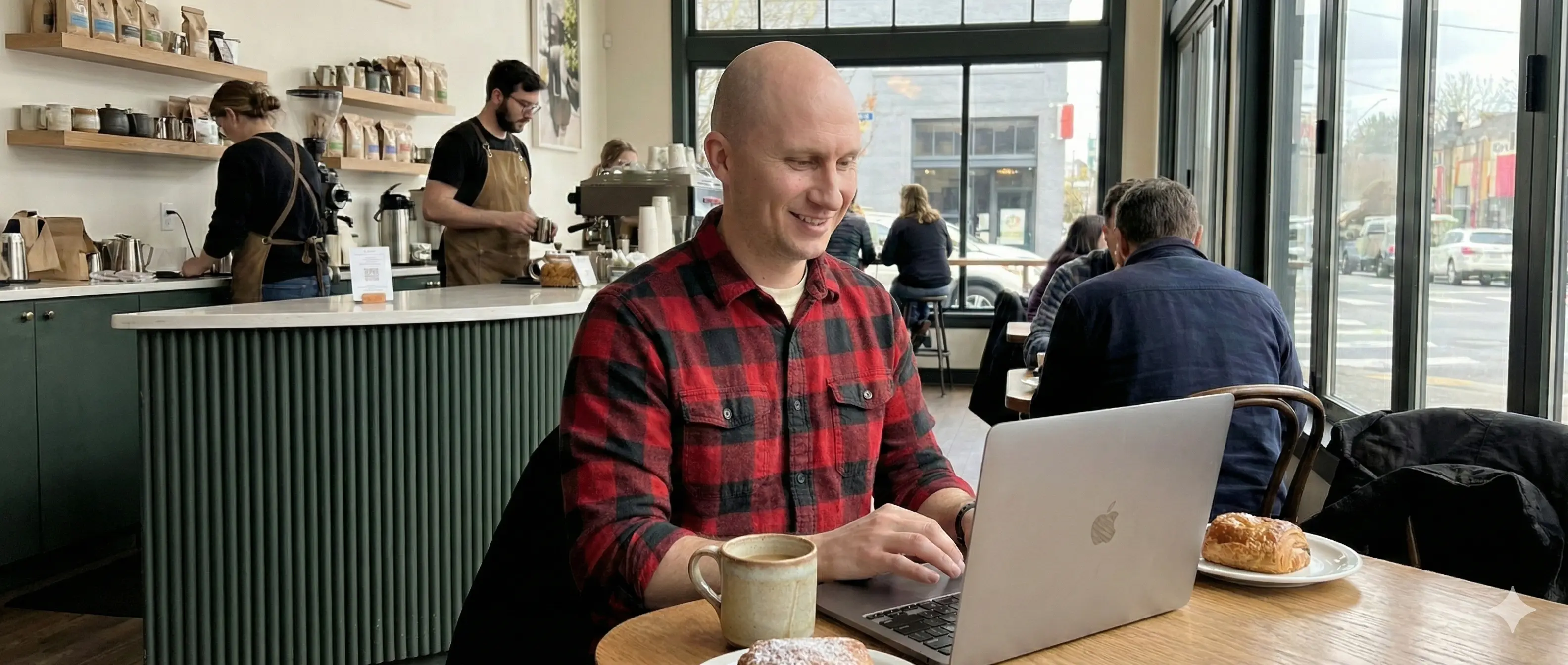

He walked in wearing blue jeans and a flannel shirt.
Dr. Patricia Corbin had every student in the JSU music department sing down the scale in front of the whole choir. One by one. She was reading the room, finding the range. When it was Matt Headley's turn, he started descending. He kept going. Lower. The choir began to react — audible surprise, then something close to gasps. He hit a D below the bass clef staff. The floor of a bass-baritone, the note where most men's voices give out entirely.
Dr. Corbin looked at Jason Wright — the choir's established bass anchor — and said: "Move over, Jason."
The choir laughed. Jason moved over. Matt had a place.
He grew up in Oxford, Alabama, in a Catholic family that moved there in 1993. His mother raised him in the church. His father had been a Marine. When Matt was ten, a scandal involving his father disrupted everything — the family dropped to the bottom of the socioeconomic ladder, moved into a smaller apartment, and navigated the social consequences that follow a family's visible fall. He has not written publicly about that chapter yet.
He left for engineering at the University of Alabama. A volatile relationship self-destructed. He stopped going to class. He has written about what happened next: a park bench in Tuscaloosa, a traveling minister who sat down beside him and prayed, a classmate at the Catholic student center who gave him a guitar — a black Sigma acoustic by Martin. He still has it.
He went to Gadsden State Community College, then transferred to Jacksonville State on a full music scholarship. A classmate recommended him for a job directing the choir at Red Hill United Methodist Church in Attala, Alabama. Small congregation, rural, not far from Jacksonville. He took it because he needed the work.
"What began as a gig became a call to vocational ministry."
That's the line he used in a seminary application a few years later. He wasn't being dramatic. He meant it the way you mean something when it surprises you.
What began as a gig became a call to vocational ministry.
He directed the choir at Red Hill for three years and ran a simultaneous job at Hokes Bluff UMC leading contemporary worship. He started a youth ministry. He met Heather in a JSU music classroom — she had a red bow in her hair and a yellow duck-head shirt tucked into her jeans, and he nearly left before the class started. He stayed.
In 2007, he and a fellow student named Rocky Tejada co-founded the JSU Men's Chorale. Matt served as Vice President and Assistant Conductor — what the concert program called him was Conductor, and in practice he ran rehearsals, selected repertoire, wrote the meeting agendas, and built the roster from scratch. Fourteen singers. Fridays, five to seven, Mason Hall room 222A. Their first concert was November 17, 2007. TSHOTSHOLOZA, Moses Hogan's Witness, Joseph Martin's The Awakening, Carol of the Bells. Faculty sponsor: Dr. D'Ambrosio. Accompanist: Meg Griffin. Treasurer: Jason Wright, the bass who'd moved over.


He graduated, married Heather in the summer of 2009, and moved to Muncie, Indiana, where she pursued a graduate degree in piano and he joined the staff of First Baptist Church as Worship Arts Director. He received a full scholarship to Northern Seminary. Three years later he was ordained and promoted to Associate Pastor. He and Heather came back to Alabama in 2014 — appointed to Weaver First United Methodist Church, a congregation in Calhoun County. He stayed seven years. Then Anniston First, where he served as Associate Pastor and Music Director until 2025. Lessons and Carols. O Magnum Mysterium. A choir, a congregation, a breakfast ministry for unhoused neighbors called the Shepherd's Table.
Nineteen years total. Four congregations. Indiana and Alabama.
In 2021, he and Heather launched a cut flower farm on the property of an 1832 farmhouse in Anniston's Lenlock Heights neighborhood — the farm sitting beside the Chief Ladiga Trail, a Bloom Bar trailer parked where cyclists would stop. They grew ranunculus, foxgloves, snapdragons, zinnias. They sold at the Anniston Downtown Market. They did weddings. They learned permaculture from Trevor and Joanna Mann of WaldenFARMacy.

In the summer of 2024, he wrote about clinical depression in The Anniston Star — about sitting by the Camp Lee pool surrounded by people and feeling completely alone, about hiking into the woods with his anger, about letting go of his resistance to psychiatric medication. He called it resurrection. He thought he was through it.
He wasn't through it.
A manic episode followed. He has written about this obliquely in a piece called "I'm Not Going to Disappear" — the bipolar diagnosis that the depression alone had hidden, the farm overextension, the departure from the church. The farm sold in November 2025. The bipolar diagnosis came the same month. He spent ten days in the UAB psychiatric center.
"The farm sold while I was in the hospital. The bipolar diagnosis. A two-decade ministry career gone."
He lives in Pleasant Valley now, with Heather and their four kids. He manages the Anniston Downtown Farmers Market for the city. He writes. He built Southern Legends, this publication, as the first thing he made after the floor — a place to write about northeast Alabama people, starting with the ones nobody was watching closely enough.

On May 31, 2026, he preached at Jacksonville First United Methodist Church — the church in his hometown, the one he'd led worship at during the JSU years. He opened with: "My name is Matt Headley. I grew up in Jacksonville. Went to school here at JSU."
His text was John 12:24. Unless a grain of wheat falls into the earth and dies, it remains just a single grain; but if it dies, it bears much fruit.
His brother Justin had written an academic paper on this concept in 2007 — the Buddhist notion of sunyata, self-emptying as the path to becoming. Matt had lived it. Then preached it from his hometown pulpit, nineteen years after Justin wrote the theory down.








Responses