Two things are true about the Muscogee (Creek) Nation and Alabama.
Most of their people were removed. Some stayed.
Both of those facts are relevant to understanding what "Chief Ladiga Trail" means — and both need to be part of any serious attempt to reckon with the land this trail runs on.
The Nation That Was
Before 1832, the Muscogee people occupied most of what is now Alabama and Georgia. The Creek Nation — the confederacy of towns that European settlers called "Creek" after the waterways where they built — was one of the largest and most sophisticated Native nations in the eastern United States.
They were farmers, traders, diplomats, and warriors. Their town system was complex. Their political structure was decentralized in ways that made European treaty negotiation both difficult and exploitable — what one chief signed, another town might not recognize.
For thirty years before the Treaty of Cusseta, the United States government applied increasing pressure on Creek leadership to cede land. Three major cessions — 1805, 1814, and finally 1832 — progressively moved the boundary west and south until what remained was this: the last 5.2 million acres of Creek homeland in northeast Alabama, ceded by the treaty Ladiga signed.
The Road of War
Removal didn't happen overnight.
The Treaty of Cusseta converted Creek communal land into individual allotments — a legal mechanism that made dispossession faster. What followed was a period of intense fraud and coercion: speculators bought Creek allotments under conditions that ranged from legally questionable to outright theft. Within two years, most Creek families had lost what the treaty had promised them.
The Creek War of 1836 — the last armed resistance — ended with defeat and military removal. The U.S. Army oversaw the forced march west of roughly 15,000 Creek people to Indian Territory in what is now Oklahoma. The Muscogee Nation calls this the Road of War. Hundreds died in the march. The nation reconstituted itself in the new territory with extraordinary resilience, rebuilding governance, culture, and community.
Today, the Muscogee (Creek) Nation is a federally recognized tribal nation seated in Okmulgee, Oklahoma. They are a self-governing nation with their own legislature, judiciary, and executive. Their cultural preservation office maintains active work on Muscogee language, history, and ties to ancestral homelands.
Contact: Historic and Cultural Preservation Department — (918) 732-7713 — muscogeenation.com
The People Who Stayed
Not everyone left.
Some Creek families hid in the hills of south Alabama. Some had intermarried with white settlers and were able to stay under different legal protections. Some simply refused.
The descendants of those who stayed are the Poarch Band of Creek Indians.
Federally recognized in 1984, the Poarch Band is the only officially recognized Creek tribe with reservation lands remaining in Alabama. They are based in Atmore, in Escambia County in south Alabama — about as far from Calhoun County as you can get and still be in the state. Their connection to northeast Alabama is historical, not residential. But they are Creek people with direct ancestral ties to the land the Chief Ladiga Trail runs on.
Contact: pci-nsn.gov
Why Both Matter
When people talk about "consulting the Creek Nation" in the context of the Chief Ladiga Trail, both nations are relevant.
The Muscogee (Creek) Nation in Oklahoma carries the primary historical continuity of the people Ladiga led. They are the institutional inheritors of the treaty, the removal, and the Road of War. Their cultural office is the appropriate first contact for any serious project about the 1832 history.
The Poarch Band in Alabama carries the continuity of those who remained. They are the Creek people who are physically present in this state. Their perspective on what the bicentennial of the treaty means — from inside Alabama — is different from the perspective of the nation in Oklahoma, and both are worth having.
Neither has been formally consulted about the 2032 bicentennial of the Treaty of Cusseta, or about what the trail that carries Ladiga's name should say.
The Gap
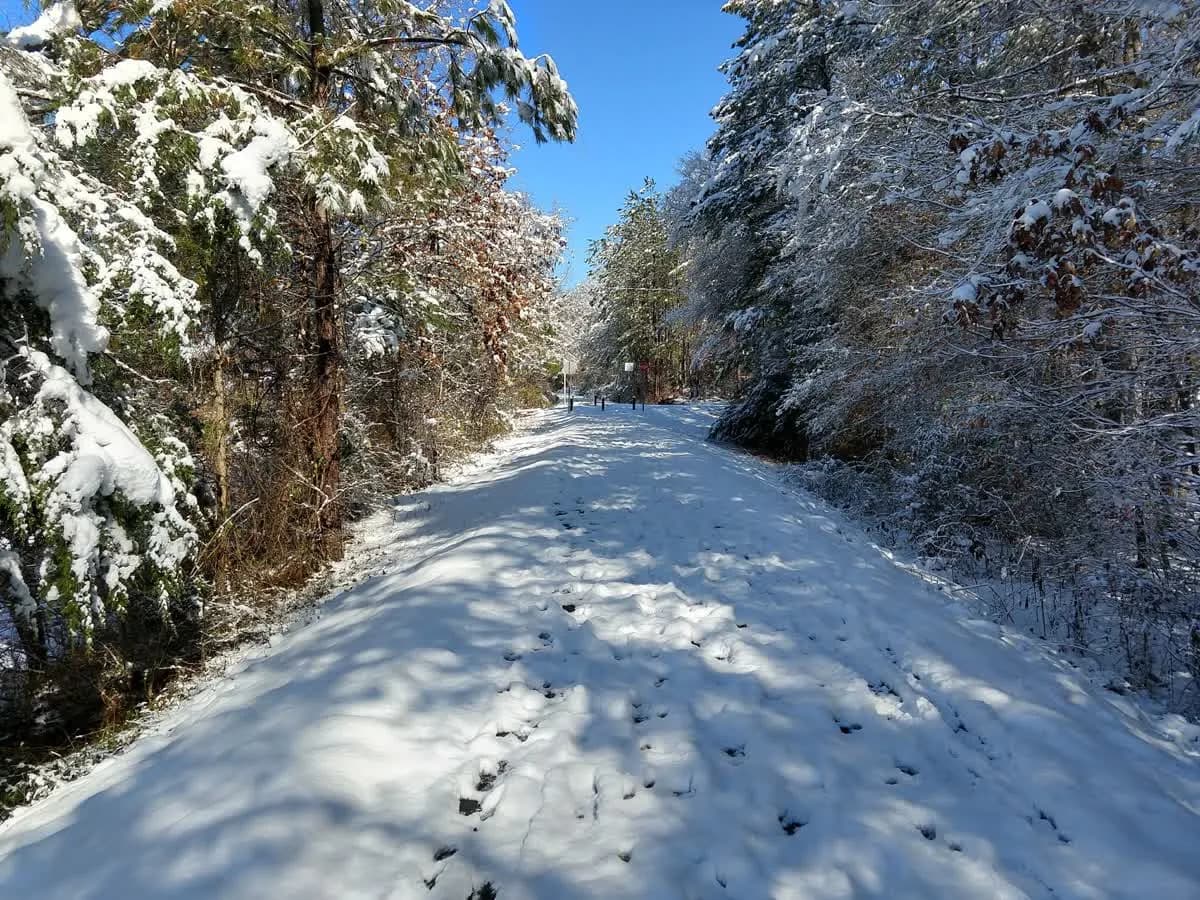
The Chief Ladiga Trail runs 33 miles through Calhoun County.
Ladiga's land — the allotment he received for signing the treaty — became Jacksonville, Alabama. Jacksonville is on the trail. The land beneath a section of that trail was, for a brief period in 1832–1833, legally Ladiga's property. He sold it for $2,000 and moved near Piedmont, where he died.
Most people who walk this trail don't know any of this. The signs don't say it. The marker doesn't say it.
A name without the story of what the name cost is a placeholder, not a memory.
The story is here. It has been here for two hundred years. The trail is named after it. The trail is waiting for someone to say so.
This essay is part of the research for The Trail and Its Reckoning, a book project about the Chief Ladiga Trail, the 1832 Treaty of Cusseta, and the 2032 bicentennial.
Who Was Chief Ladiga? → The Trail at Night → Chief Ladiga Trail →





Responses