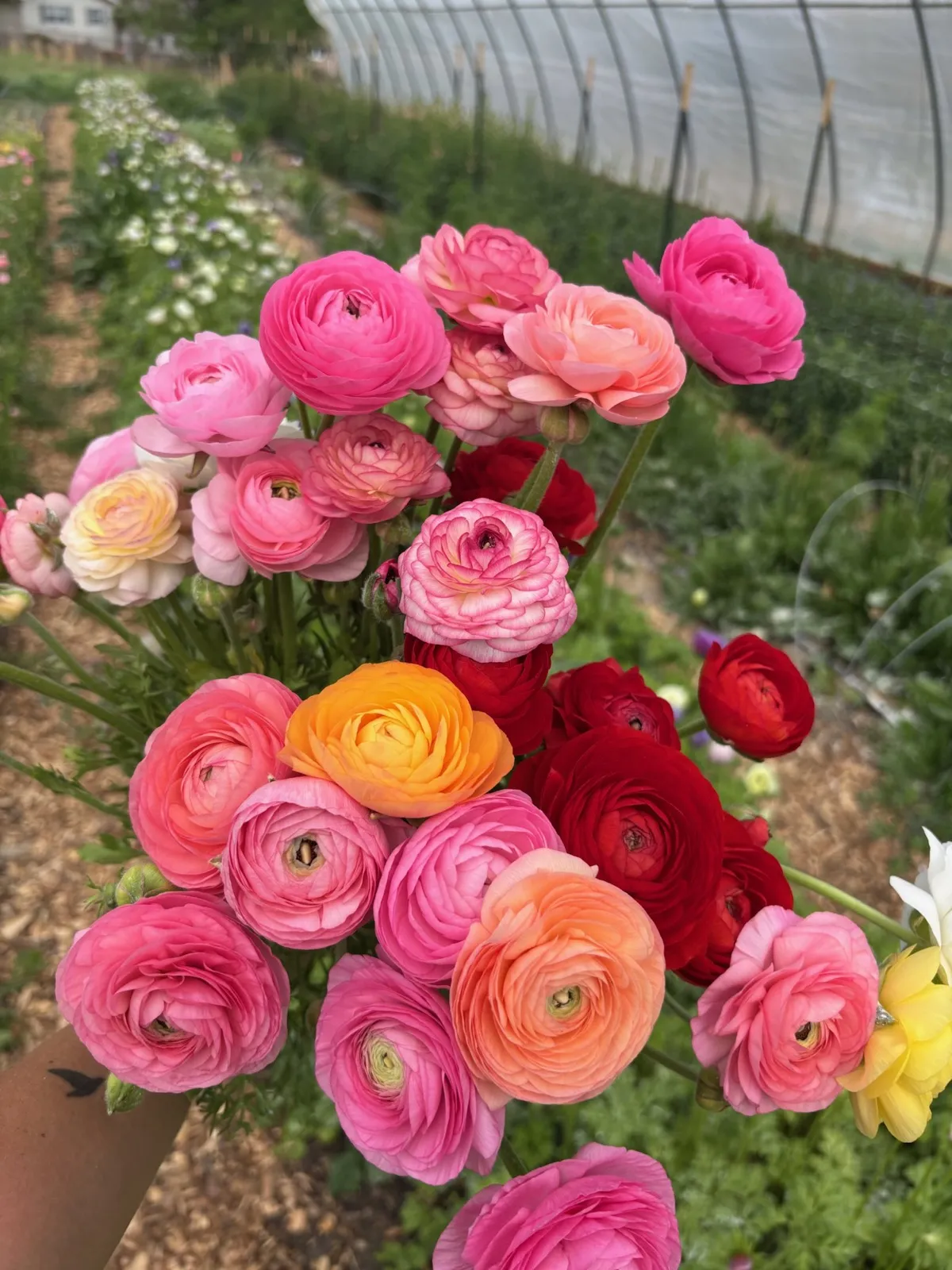
Erin Benzakein grows flowers in the Skagit Valley of Washington, north of Seattle, on a small farm called Floret. She started with a few rows. She is now the most influential flower farmer in the world, and she got there by proving something almost nobody believed anymore: that you can make a living growing flowers on a small piece of ground.
That sounds like a modest claim. It is not. For most of the last century the American cut-flower business moved offshore. The roses in the grocery store flew in from Colombia or Ecuador, cut a week ago, bred for shipping rather than scent. The idea of a local flower farm, the way there had once been local dairies and local orchards, had quietly died. Benzakein is a large part of why it came back.
My wife took her course. I need to tell you that up front, because I cannot write about Floret from a neutral distance. We built a flower farm in Alabama, and the farm we were trying to build was the one Erin Benzakein taught people they could build.
What She Built
Floret is small on purpose. The whole argument is in the scale. Benzakein did not set out to run an industrial operation. She set out to grow beautiful, unusual, seasonal flowers on a footprint you could walk in an afternoon, and to prove the economics worked.
They worked. Floret became a farm, then a seed company, then a breeding program, then a school. Benzakein and her team began preserving and breeding heirloom varieties that the industrial flower trade had abandoned because they did not ship well, which is another way of saying they were bred for beauty instead of durability. Dahlias. Sweet peas. Zinnias. The flowers your grandmother grew and your florist could not get.
The husband is part of it. Chris Benzakein runs the operations side. It is a family farm in the actual sense, which matters, because the whole Floret argument is that this is a life a family can build, not a corporation you go to work for.
The Books
Floret Farm's Cut Flower Garden (2017) is the one that broke through. It became a bestseller, which floral how-to books do not do, and it did it because it was gorgeous and because it was practical at the same time. It told you what to plant and it showed you a farm you wanted to live on.
A Year in Flowers (2020) is the arranging book, organized by season, which is the whole philosophy again: you work with what is blooming now, on your ground, in this month.
Discovering Dahlias (2021) is the specialist volume, and it is also a small act of preservation. Floret's dahlia work has helped keep rare varieties alive.
The books are beautiful in a way that is easy to dismiss as lifestyle content and is actually the argument. Benzakein makes the local, seasonal, small-farm life look desirable, on purpose, because desire is how you get people to try the hard thing.
The Show
Then came television. Growing Floret ran on Magnolia Network, Chip and Joanna Gaines's channel, and streamed on Discovery+. It followed the farm through the season, the breeding trials, the family, the work.
The Gaines connection is not incidental. Magnolia built an empire on the same instinct Benzakein has: that a large number of Americans are homesick for a rootedness they never had, and will follow anyone who shows them a version of it that feels real. Floret feels real because it is. Benzakein is not an actor playing a farmer. She is a farmer they put on television.
The Course
This is the part I know from the inside, secondhand, through Heather.
The Floret Online Workshop trained a generation of flower farmers. It is not a hobby class. It is the business, the succession planting, the crop plan, the harvest and post-harvest handling, the actual math of making a small flower farm pay. People took that course and started farms. There is a whole network of small flower operations across the country that trace directly back to it, and Heather Florals is one of them.
Heather took the course. She is in the Floret community, the online one, where thousands of women who grow flowers for a living compare notes on the same problems, the same pests, the same impossible week when everything blooms at once and the wedding is Saturday. That community is one of Benzakein's quieter accomplishments. She did not just teach people to farm flowers. She connected the people who did, so that a woman on a few rows outside Anniston is in the same room as a woman on a few rows outside Portland.
Why It Matters Here
We built a flower farm. Nine acres near the Chief Ladiga Trail, an 1832 farmhouse, drip irrigation I calculated by hand off flow-rate charts at the kitchen table, ranunculus and dahlias in the beds, a retail kiosk on Ridgewood Avenue. Heather grew what she sold. I ran the water and the sheep and the math. All four kids worked it.
The farm is gone now. That is a longer story and it belongs to a different piece. But I cannot write about Erin Benzakein without saying that Floret was the north star of a thing we tried and did not keep. The course Heather took was not a failure. The farm it helped her build was real, and the floral studio it grew into is still standing even though the farm is not. Heather Florals outlived the field.
That is worth understanding about the flower-farm movement Benzakein started. The point was never only the land. It was the knowledge, the craft, the network, the ability to grow something beautiful and sell it into your own community instead of importing it from a hemisphere away. That part survived for us. The dirt did not. Both of those are true.
I built the software company that came after partly out of this. Petal Studio exists because I watched Heather run a flower business by hand and knew what the tools should have done for her. Everything downstream of the farm carries the farm in it.
Where to Start
If you want to grow flowers: Floret Farm's Cut Flower Garden. Read it before you buy a single seed.
If you want to understand the movement: watch Growing Floret. It is quiet and it is beautiful and it will make you want to put something in the ground.
If you actually want to farm flowers for a living, the workshop is the real thing, and the community that comes with it may be the more valuable half.
Erin Benzakein is still on the farm in the Skagit Valley. So is the movement she started. Ours did not last. Hers did, and because it did, ours was possible in the first place.
See also: What Heather Grew, the story of the farm and the floral studio that outlived it. And I Collected Farmers Before I Ever Kept a Farm, the book these profiles are becoming. For the men who taught the land the same lesson from the other direction: Wendell Berry and Justin Rhodes.



Responses