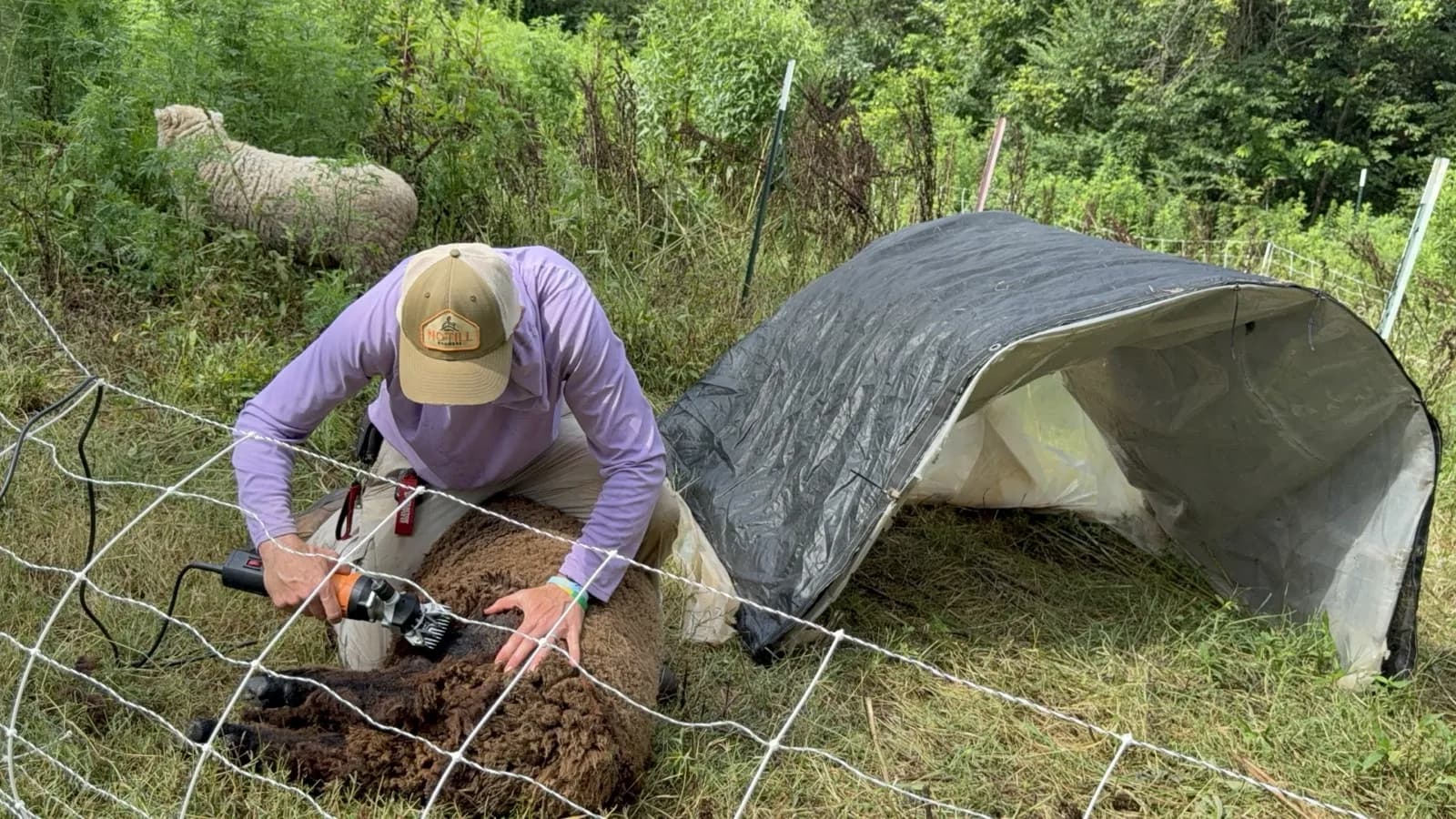
There is a wheel hoe in the hero photo of the farming book this profile belongs to. It is a simple tool, a wheel and a blade and two handles, and it is the single object that best explains a quiet revolution in American agriculture. That tool, and the whole method around it, came from two men: Eliot Coleman in Maine and Jean-Martin Fortier in Quebec.
They answered the question that stops most people before they start. Can you actually make a living farming a small piece of ground by hand? For most of the last century the answer from agricultural economics was no. Get big or get out. Coleman and Fortier proved otherwise, worked out the proof in detail, and then, crucially, wrote it down so anyone could follow it.
Eliot Coleman
Coleman is the elder. He has been farming in Harborside, Maine, at a place called Four Season Farm, since the 1960s, on land he bought a piece of from the writer Helen Nearing. He is a organic grower from before the word organic meant anything to anyone, and he built his method by studying the intensive market gardens of France and adapting them to a cold coast in Maine.
His central, almost stubborn insight is that you can grow food twelve months a year, even in Maine, without heating a greenhouse, by using unheated tunnels and cold-hardy crops and the tilt of the winter sun. The New Organic Grower (1989) is the foundational text. The Winter Harvest Handbook is the cold-season argument in full. Four-Season Harvest is the version for the home gardener.
Coleman also designed tools. The broadfork, the collinear hoe, the low tunnels, many of the hand tools a modern market gardener reaches for came through him, refined for a person working beds by hand rather than a machine working acres. He is married to Barbara Damrosch, herself a fine garden writer. The two of them have spent decades proving that a small farm is not a lesser version of a big one. It is a different thing, with its own economics, that works.
Jean-Martin Fortier
Fortier is the younger man who took Coleman's argument and sharpened it into a business plan. On a farm called La Grelinette in Quebec, Fortier and his wife Maude-Hélène Desroches made a real living, employing people, on about an acre and a half of hand-worked beds, no tractor. Then he wrote The Market Gardener (2014), which did for the commercial small farm what Benzakein's book did for flowers: it made the thing look possible and gave you the numbers to prove it was.
Fortier's method is permanent raised beds, no-till or minimal-till, tight standardized spacing, and a small set of good hand tools used well. The grelinette that gave his farm its name is the broadfork, the French tool for loosening soil without turning it over and destroying its structure. The wheel hoe is for keeping the weeds down between crops fast enough that a small crew can manage a lot of beds. It is a system, and its genius is that it is teachable and repeatable.
He went on to build the Ferme des Quatre-Temps and a whole training operation. There are now thousands of small commercial farms running the Fortier method, many started by people who never met him, working from the book.
Why the Method Matters
The reason to put these two men in a book about agrarian heroes, next to Wendell Berry and Joel Salatin, is that Berry and Salatin tell you why to farm and Coleman and Fortier tell you how, at a scale a family can actually reach. Berry gives you the theology of place. Salatin gives you the moral argument for how animals and land should relate. Coleman and Fortier give you the beds, the spacing, the tools, and the honest arithmetic that turns a conviction into a Tuesday.
I dug my beds their way. Thirty-inch beds, walkways between, drip tape down the rows, the same standard measurements a hundred thousand other small growers use because Coleman and Fortier worked them out and shared them. When Heather grew flowers for market, the field was laid out on their geometry. The method does not care whether you are growing lettuce in Quebec or ranunculus in Alabama. That is the whole point of a method. It travels.
Our farm did not last. The method was never the reason a farm fails. The method is the part that works. Coleman is still in Maine. Fortier is still in Quebec. And the beds they designed are cut into ground on every continent, including a stretch of red clay near the Chief Ladiga Trail where they held flowers for a few good years.
Where to Start
If you want to grow food to live on: The Market Gardener by Jean-Martin Fortier. It is the fastest path from wanting to doing.
If you want the deeper, slower foundation: The New Organic Grower by Eliot Coleman.
If you want to grow through the winter and think it is impossible where you live: The Winter Harvest Handbook. Coleman has been proving you wrong from Maine for forty years.
See also: I Collected Farmers Before I Ever Kept a Farm, the book this profile belongs to. For the flower-farm version of the same method, Erin Benzakein. For the why beneath the how, Wendell Berry and Joel Salatin.




Responses