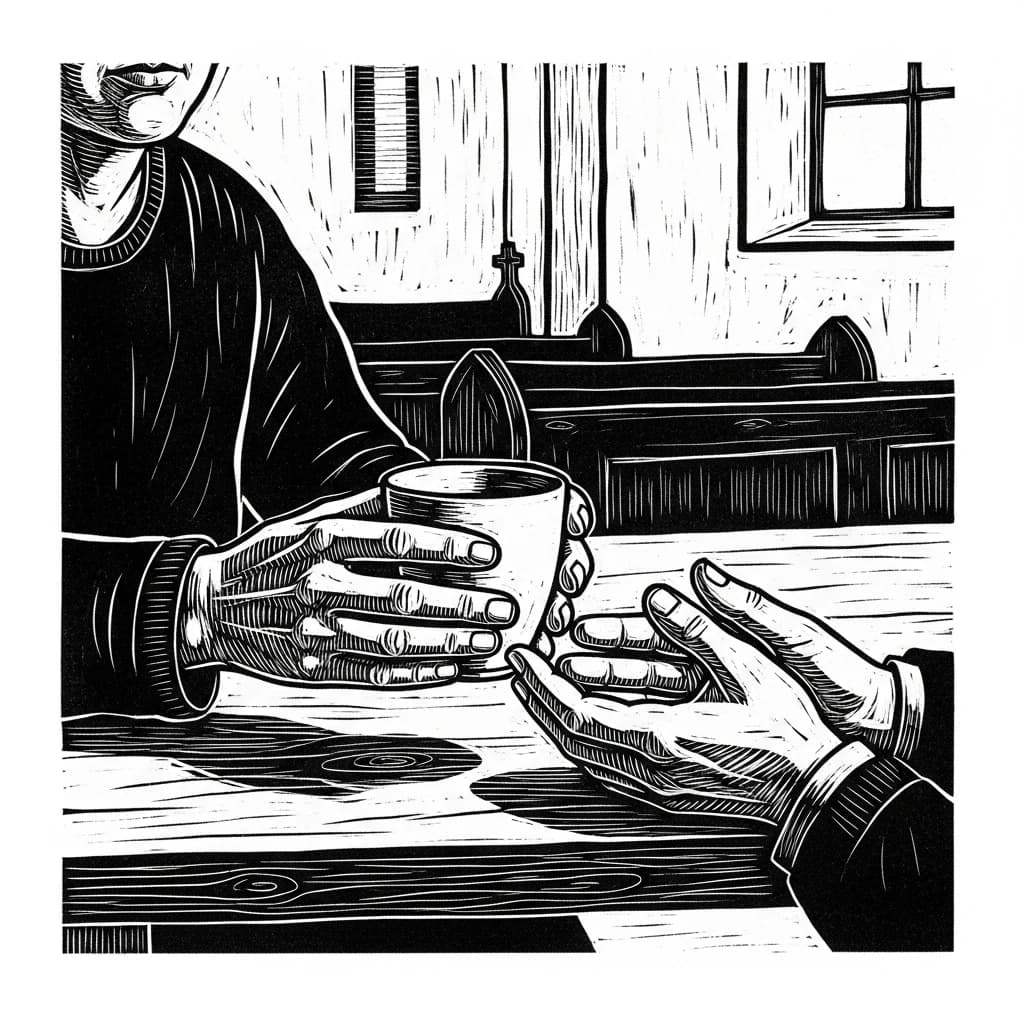
There's a painting I keep thinking about. William Christenberry grew up in Hale County, Alabama, ninety miles southwest of here. He spent his career driving back every summer to photograph the same buildings, a church, a barbershop, a Klan-owned store he photographed for decades until it finally fell in. The buildings decayed in the pictures. They decayed in real life. He kept going back.
That is Southern Gothic in one sentence. You keep going back to the ruin because the ruin is trying to tell you something.
Flannery O'Connor grew up in Savannah, kept peacocks, had lupus, and wrote about grace the way a doctor writes about open wounds, with precision and without sentiment. She said her characters were grotesque because that's what happens when you write about people who haven't found grace yet but are about to be hit by it. The deformity isn't the point. It's the opening.
I'm a former pastor from Pleasant Valley, Alabama. I know something about this.
The Southern Gothic tradition. O'Connor, Faulkner, Carson McCullers, Harry Crews, Barry Hannah, the whole fractured line of them, is misread when people treat it as Southern self-loathing. It's the opposite. It's Southern self-examination. The region keeps writing about its rot and its violence and its grief because those things happened and are still happening, and a literature that looks away from them isn't literature. It's a brochure.
The same is true of the music. Hank Williams died at twenty-nine, most of him already gone before then, and left behind a body of work about longing that cuts clean as a knife. Jason Isbell, who grew up down the road in Green Hill, wrote a song called "Cover Me Up" that is probably the most accurate thing I have ever heard about what it means to stop drinking and love someone and be terrified of both. Drive-By Truckers spent twenty years writing about the South's unresolved history with a double album called Southern Rock Opera and a lyric that goes: The distance between what happened here and what they say happened here is the distance between life and fiction. That's the whole project in one line.
I started Southern Legends because I wanted to write about this place without flinching and without touristing it. The profiles I've done, the farmers, the ironworkers, the church musicians, the women keeping small businesses alive on Main Street in towns everyone forgot, those are Southern Gothic in the root sense. People living fully in a landscape that is beautiful and broke and refusing to pretend otherwise.
The visual tradition is the same. William Eggleston shot the Mississippi Delta in color when everyone said color photography wasn't art. His pictures look like evidence. The light in them is the light I grew up under. Birney Imes went further into the Delta and came back with juke joints and back porches and faces that looked like they'd been through something. Shelby Lee Adams photographed Appalachian Kentucky families for forty years and got accused of exploitation, which misses the point entirely, the families kept inviting him back. They wanted the record.
I've been thinking about what it means to bring this tradition into Southern Legends. Not as an aesthetic pose. Not as a content category with a logo. As an honest frame for what we're already doing, writing about place and people and the things that stay with a region long after the glossy version moves on.
The South has always had this. The question is whether we name it.
I think we name it. I think we start talking about the art and the music and the literature that comes out of this specific kind of attention, the attention that goes back to the ruin, that photographs the same falling church ten years in a row, that writes the song about the thing everyone else is too polite to say.
Christenberry kept going back to Hale County until he died in 2016. The buildings he photographed are mostly gone now. But the photographs are in the Smithsonian.
The ruin doesn't have to last. The act of going back is what matters.
This is a working essay. More coming on Southern Gothic art, music, and photography, including regional artists you've never heard of who are doing this work right now.


Responses