
 Bridal ShowThe Aisle Bridal Show · Sunday, Feb 21 · Silver Run Chapel, Munford · theaislebridalshows.comRegister free →
Dolly Parton was born in a one-room cabin on the Little Pigeon River in Sevier County, Tennessee, in 1946. She was the fourth of twelve children. Her father was a sharecropper. Her grandfather Jake Robert Owens was a Church of God pastor.
She performed publicly in her grandfather's church at six years old.
She moved to Nashville the day after she graduated high school in 1964, the day, not a week later, not after the summer. The day.
Everything between the church and Nashville, and everything after Nashville, is a continuation of what began in her grandfather's pulpit in the Smoky Mountains. This is not a metaphor or a framing device. It is the straight biographical line.
The Pentecostal Formation
The Church of God is a Pentecostal tradition, shouting, healing, prophecy, glossolalia, the Spirit moving through bodies in ways that mainline Protestantism still does not know what to do with. Dolly Parton grew up in a church where the Holy Ghost was expected to show up and make things happen, where music was not performance but prayer, where the congregation was a body that moved together.
That formation is audible in everything she does.
"Coat of Many Colors" (1971) is a sermon. It is the story of her mother sewing a coat from rags for young Dolly, the other children mocking the coat, and young Dolly understanding that the coat meant something the other children were too poor in spirit to see. She sings it with the calm certainty of someone who has already resolved the theological question. The coat is not a consolation. It is abundance. The Pentecostal formation teaches you that what the Spirit gives is sufficient regardless of what the world assigns.
"Jolene" (1974) is a lament in the Old Testament mode, direct address to the source of threat, honest about fear, not pretending to be stronger than she is. The church tradition that formed her is full of that kind of honesty. You do not perform strength in a Pentecostal service. You come with what you have and trust that the Spirit will do what you cannot.
"I Will Always Love You" (1973/1974) is a benediction. She wrote it about leaving her professional partnership with Porter Wagoner, a song of release that is also a blessing. The church does not prepare you for anything so much as it prepares you for endings. How to let go. What to say when you go.
What People Miss
The theological substance of Dolly Parton's work gets flattened in two directions.
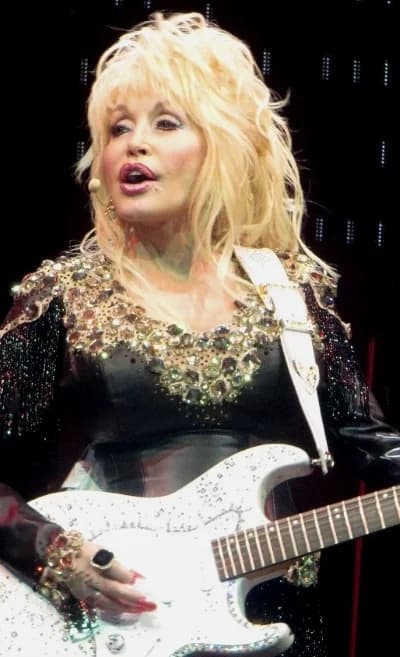
The first flattening is the camp version, Dolly as icon, as drag inspiration, as deliberately outsized persona whose sequins and wigs are the point. The persona is real and she built it intentionally. But the persona is not the whole thing. It is armor and art simultaneously, and if you only see the sequins you are missing what is inside them.
The second flattening is the wholesome pop-culture version, Dolly as universally beloved, the person everyone agrees on, the safe celebrity. She is genuinely beloved and she has been careful not to become a political prop for anyone. But the cost of that care is that she gets discussed as a personality rather than as a serious artist with a serious theological framework.
Her serious theological framework: human beings have dignity regardless of what the world assigns them. The coat of many colors is worth more than the other children's coats. The woman who has nothing has something. This is not prosperity gospel, she is not saying faith produces wealth. She is saying something closer to the Sermon on the Mount, which is that the accounting system that says some people matter more than others is wrong at the root.
She learned this in her grandfather's church in the Smoky Mountains. She has been singing it for sixty years.
The Imagination Library
In 1995, Parton founded the Imagination Library in Pigeon Forge, Tennessee, her home county, to provide free books monthly to every child from birth to kindergarten enrollment, regardless of family income.
The program now operates in every U.S. state, Canada, Australia, the United Kingdom, and Ireland. It has gifted over 230 million books.
She funded it from her own earnings. She started with the county she grew up in because she knew what it was to have no books.
This is not a celebrity charity project. It is a sustained, thirty-year institutional commitment to the specific community that formed her, extended outward. It is the Pentecostal tradition of giving to your community practiced at scale with the resources a sixty-year career produced.
Where to Start
Coat of Many Colors (the album, 1971) is the beginning. Then Jolene (1974), then The Bargain Store (1975). These three albums are the theological core.
Dolly: My Life and Other Unfinished Business (her 1994 memoir) is honest about the poverty, the work, and the theology. She does not romanticize the cabin on the Pigeon River. She is matter-of-fact about what it was and what it produced.
The 2019 Netflix documentary series Dolly Parton: Here I Am is worth watching for the biographical arc.
She has a song called "Better Get to Livin'" that is more or less Philippians 4 set to a country chord progression.
She is ninety-one years old. She is still in East Tennessee.
Wait, I have that wrong. She is seventy-nine. She is still in East Tennessee.
She was right about most of it.
See also: What Sinners and Jason Isbell Know About Alabama That Alabama Won't Admit, on the Pentecostal roots of Southern musical honesty. And Fred Craddock Drove to the Small Churches for Free, on the other form of Appalachian theological seriousness that the academy has underestimated.




Responses