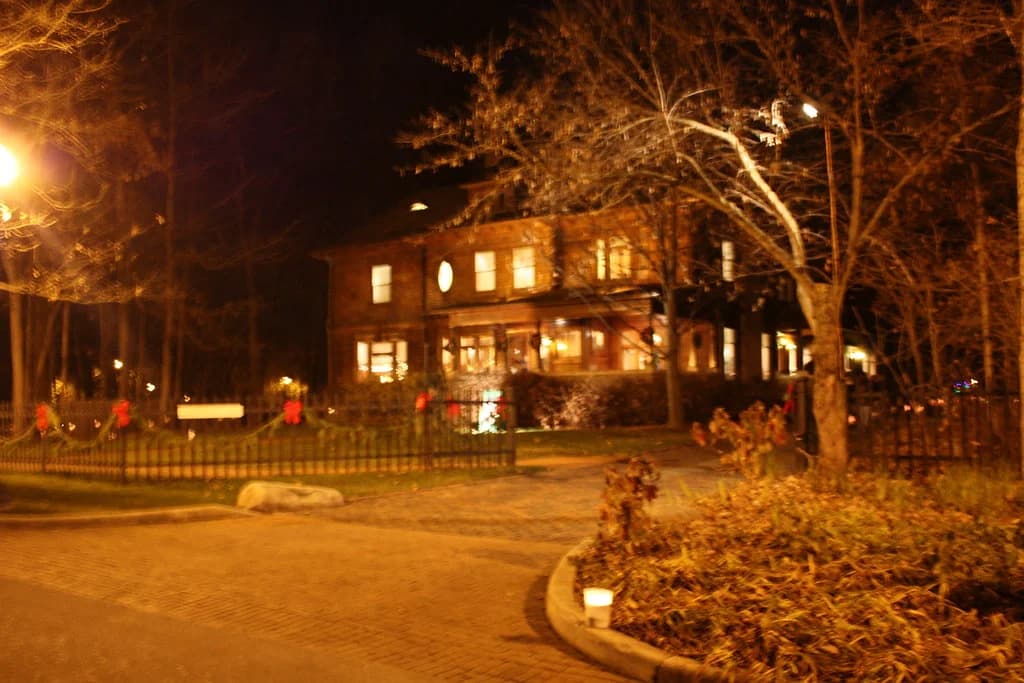
We did not always live on a country road.
When we were newlyweds in Muncie — first a trailer, then our first house — we walked sidewalks. Hours of them. The practice started there, on those flat Indiana streets, before kids, before the demands that would make the walk feel like a discipline rather than just what we did. Some of the best conversations we have ever had happened on those sidewalks. The location changes. The practice does not.
I went to Indiana at twenty-four. I said I was pursuing a graduate degree and joining a church staff. That was true.
The longer answer: I didn't know yet what I was made of, and Alabama wasn't going to tell me.
[Write your line here: what the YFC job was on a Tuesday — what you actually did with Muncie High School kids. Two or three sentences. Report it, don't introduce it.]
My boss at the time was Wade Allen, senior pastor at First Baptist. He drove me south to Indianapolis every Monday for our staff meeting, which meant the meeting was over when we hit the city, and then I walked to the Megabus stop alone. Half a tablet of Dramamine, a window seat, and a social ethics paper half-finished in my lap. The bus cost about twenty dollars. Northern Seminary cost something I do not want to calculate now.
The seminary was in Lombard, Illinois. At the Lombard station I'd walk three blocks north to the parking lot of a United Methodist church. My brother Justin's 1989 Ford Ranger was there — navy, five-speed — left all week while I was back in Indiana doing ministry. The man who plowed that lot had opinions about this, which he expressed by burying the truck. I dug it out with my hands multiple times. Illinois winters, no gloves, books under my arm. Climbed in, turned the key, eased it into first, drove to class.
That is, I think now, the exact texture of formation. You don't own it. You take care of it. You show up, you dig, you go.
One winter I was standing at a bus stop in Chicago with a crowd of strangers. A man was working his way down the line. I had my headphones in. I gave him the standard response before he could finish.
He stopped. His face changed.
The least you could do is listen to me, man. I was trying to ask you a question.
He kept walking.
I took my headphones out. My heart did the thing it does when you have done something small and wrong and you know it and you cannot undo it. He was gone.
I had been in seminary for over a year by then. Reading about incarnational ministry. Hearing Wayne Gordon talk about showing up in a neighborhood no one is investing in — anything worth doing is worth doing poorly, he said in a classroom at Northern Seminary, and I wrote it in my notes and circled it. And I had my headphones in.
Early in our marriage, Heather and I tried to model our life together on another couple — a senior pastor and his wife in Muncie. We admired them. We studied how they moved through the church, how they handled conflict, how they presented themselves. We were trying to build something, and we were using someone else's blueprint.
The first marriage retreat we attended, we drove from Indiana down to WinShape at Berry College in Rome, Georgia. Not because things were bad. Because someone told us it was worth doing before things got hard.
Most of the formation that mattered happened that way. Not in a lecture hall. On sidewalks, on the Megabus, at a bus stop in December. In a church where I showed up before I knew what I was doing. At a retreat we drove twelve hours to get to because we were trying to figure out what it meant to stay.
In 2014, I came back South.
I was appointed pastor at Weaver First United Methodist Church. The Chief Ladiga Trail runs right through Weaver. The parsonage was an eighth of a mile from it.
[Write your line here: one sentence on coming back. What you noticed first. The Alabama detail in front of you that first week — not the reflection, the fact.]
The sidewalk walks became trail runs. The YFC youth work became pastoral ministry. The formation practices from seminary became the Attune framework I built years later. The homeless man at the bus stop became a reference point I kept returning to — what it means to be present to another person, or what it means to fail at it.
None of it looked like preparation at the time.
Southern Legends is not a directory of Northeast Alabama businesses. Plenty of those exist.
This is something else: the story of people who left and what they brought back. The education that happened elsewhere. The sidewalk practices that moved to county roads. The formation that looked like a detour.
I am the prototype. Born in California. Lived in Gabon, Egypt, and North Carolina before my family landed in Oxford, Alabama. Left for Jacksonville State. Left again for Muncie. Came back to Weaver. Now in Pleasant Valley, eight miles from where I started.
What Indiana gave me, Alabama eventually used.
[Write your closing image here: the trail, the sidewalks now vs. then, a moment with Heather or the kids, something specific and concrete — not the argument, the image.]
Matt Headley is a former pastor, former flower farmer, and the founder of Gather Studio in Anniston, Alabama. Southern Legends is his long-form project on the people and places of Northeast Alabama — including the ones who left and came back.



Responses