
 Bridal ShowThe Aisle Bridal Show · Sunday, Feb 21 · Silver Run Chapel, Munford · theaislebridalshows.comRegister free →
Sinners opens with two brothers returning to Mississippi in 1932 with a suitcase full of money and the idea that they can build something that belongs to them. They open a juke joint. By nightfall, vampires have arrived.
Ryan Coogler is not making a metaphor. Or rather, he is making a metaphor, but the vampires are also real vampires, and the juke joint is also a real juke joint, and the music that the musicians play that night is also real music, the kind of music that, as one character explains, reaches back through time and pulls every version of itself into the room at once. The past and the present and the future collapse into the same song. That is the film's theological claim, and it means it.
I grew up in Northeast Alabama. I am a former pastor. I have stood in front of congregations and made theological claims I meant. I know what it looks like when a piece of art means what it says, and Sinners means what it says.
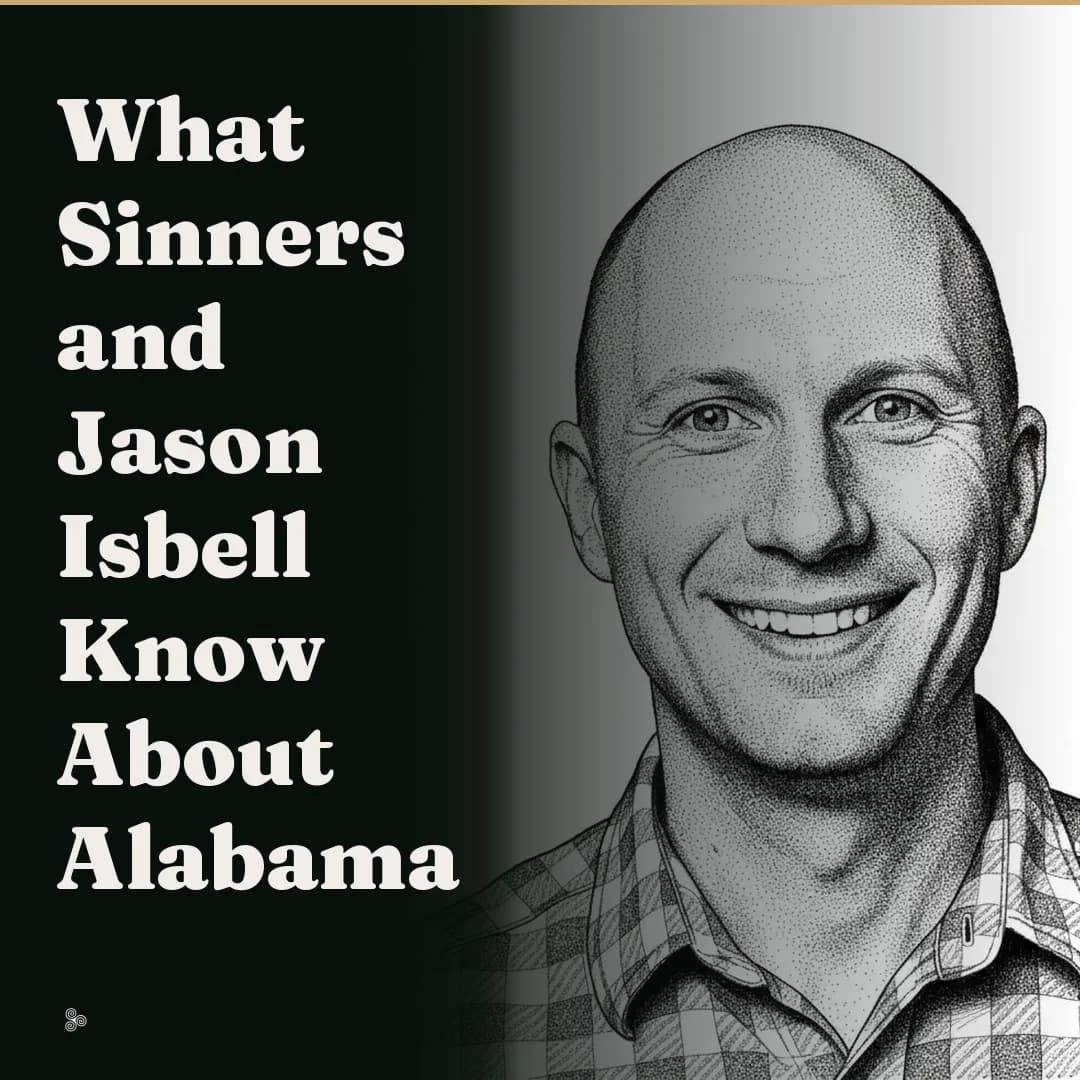
Jason Isbell grew up in Green Hill, Alabama, thirty miles from where I'm sitting. He has spent twenty years making records that mean what they say. Southeastern, from 2013, is the record, sobriety, marriage, the terror of trying to be well, the specific Alabama grief of staying in a place that is beautiful and damaged and yours anyway. "Cover Me Up" is the most honest song about love I have heard in a long time, and what makes it honest is that it is also a song about fear. The love and the fear are not separate things.
Sinners and Isbell are doing the same project. They are telling the truth about the South's beauty and its violence without letting either one cancel the other out. That is harder than it sounds. Most things that engage with the South's history of racial violence either aestheticize it or condemn it, and both moves are ways of not looking at it directly. Coogler and Isbell look directly.
In Sinners, the violence is inseparable from the beauty. The music that saves is also the music that summons. The juke joint that represents Black joy and autonomy and community is also the place where everything comes apart. This is not pessimism. It is accuracy. The South is a place where beauty and violence have always lived in the same building, and the most honest art about it does not pretend otherwise.
Isbell's "White Man's World," from The Nashville Sound (2017), says it plainly: I'm a white man living in a white man's world / under the thumb of the powers that be. He wrote it in 2017 and has been singing it since at shows in Alabama and Tennessee and Georgia, to audiences that are mostly white, which is either ironic or the point, probably the point. He is not singing it to congratulate himself. He is singing it because the thing needs to be said, and because he is in a position to say it to the specific audience that most needs to hear it, and because looking away is not an option he has allowed himself.
I am a white man from Alabama writing about Southern Gothic art. I want to say that plainly, the way Isbell says things plainly, because the alternative is to write as though I am a neutral observer, which I am not. My family has been in this part of Alabama for generations. I grew up in the church. I served in the church. I know what the church built and what it enabled and what it looked away from, and I am still sorting through what that means for someone like me who loved it and was harmed by parts of it and came out the other side trying to tell the truth.
Sinners ends. I will not say how, only that it earns its ending, with a sense that what was built mattered even though it was destroyed, that the music that was played that night was real even though the night was also a catastrophe. Isbell's records end the same way. Something More Than Free closes with "To a Band That I Loved," which is a song about loss that is also somehow not entirely about loss. The grief is real and the love is real and neither one cancels the other.
That is the Southern Gothic tradition at its best. Not the ruin for its own sake. Not despair as an aesthetic. The thing that remains after the ruin, which is sometimes just the act of having gone back and looked at it honestly.
Coogler made a film that looks directly at what this region built and what it destroyed and what it could not destroy. Isbell has been making that record for twenty years.
Both of them are from here.
That matters.
See also: The Grotesque Is the Gospel, on the Southern Gothic tradition and what it's trying to say. More on Ethel Cain, Jesmyn Ward, and the contemporary artists carrying this work forward, coming soon.



Responses