

Part of an ongoing set of essays on the shape underneath the work: What the Triskelion Means · Trust the One Who Walks With a Limp
I grew up behind a Walmart.
Not metaphorically. The farm where I spent summers was in a hollow in Calhoun County, maybe a half mile off the road where the Walmart sat. You could see the parking lot lights from the field on a clear night. Two worlds, twenty minutes of walking. One world ran on six crops. The other ran on ten thousand.
I didn't have the vocabulary for what I was looking at. I just knew that the farm felt alive and the parking lot felt efficient, and that those are not the same thing.
It took me thirty years to find the through-line.
One Shape
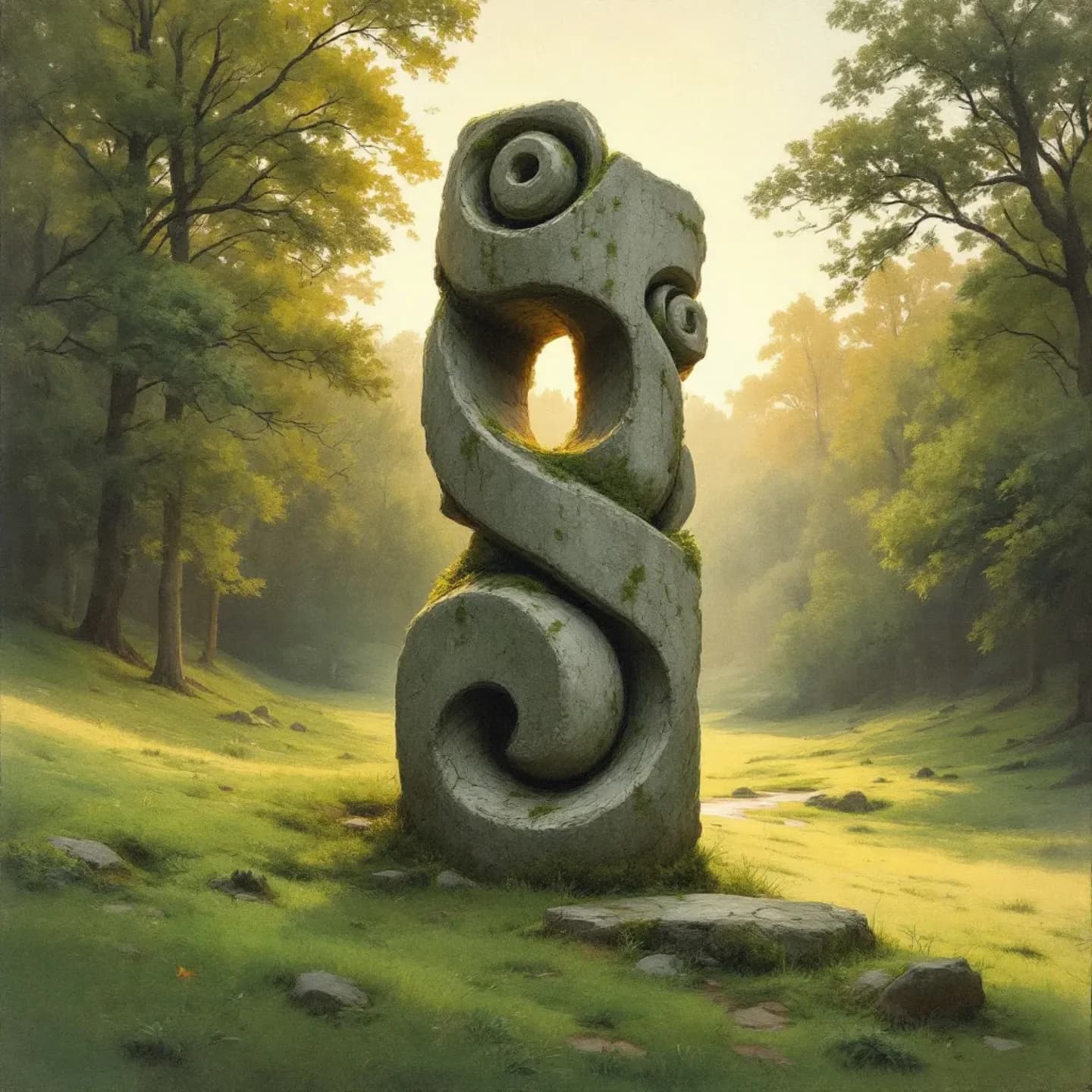
There is a symbol carved into the entrance stone at Newgrange in Ireland. It is older than the pyramids, older than Stonehenge, older than most of what we call civilization. Three spiral arms, radiating from a hollow center. No hub. No managing fourth thing at the middle. Just three arms in motion, rotating around an emptiness that holds them.
The Irish called it a triskelion. The Celtic monks put it on their gospel manuscripts. The early church used it to describe the Trinity: Father, Son, Spirit, three persons in eternal motion, none managing the other, the whole thing held together by mutual indwelling rather than hierarchy. The technical term is perichoresis. The dance of God.
I have been finding this shape everywhere I look.
The Farmer
Joel Salatin runs Polyface Farm in Virginia's Shenandoah Valley. The farm runs on a stacking system: cattle move through a field, the chickens follow three days later to scratch through the manure and eat the fly larvae, the pigs follow after that to root out the parasites. Each species doing what it was built to do. Each operation feeding the next. No center. No hub. The whole system produces more per acre than any monoculture around it, because the motion is the mechanism.
Salatin calls it a dance.
When the Irish consolidated 4,000 varieties of potato down to one — the Lumper, because it outyielded everything else — they made the same mistake every monoculture makes. The optimization was real. The vulnerability was invisible. One pathogen, and a million people starved.
The farm behind the Walmart was running something closer to Polyface. The Walmart was running something closer to the Lumper.
Efficient until it wasn't.
The Church
Mike Breen is a British church planter who mapped what he calls the three dimensions of discipleship: UP (toward God), IN (toward community), OUT (toward the world). Not a sequence. Not a hierarchy. Three simultaneous orientations, each one checking the other. A church that is all UP and no OUT becomes spiritual narcissism. A church that is all OUT and no IN burns out its people. A church that is all IN and no UP becomes a club. The health of the organism depends on the motion held between all three.
Alan Hirsch, in his mapping of the New Testament church, found five distinct load-bearing functions: apostle, prophet, evangelist, shepherd, teacher. The institutional church collapsed these into one job title. The senior pastor became the hub, the center, the single point through which everything had to move.
The result is what it always is. One pest, one scandal, one departure, one burnout, and the whole thing goes wrong in the same direction at once.
The polycentric church — the one where Nathan can still tell David he's wrong because Nathan isn't on David's payroll — is not less organized. It is organized differently. Three arms. No hub.
The Self
Richard Schwartz spent decades mapping what he calls the Internal Family System: the multiplicity of voices inside a single person. The inner critic. The protector. The exiled parts. The part that needs to be seen. The part that already knows better. The healthy inner life is not the one that has suppressed all the competing voices into one dominant narrative. It is the one where the parts are in dialogue, where no single voice manages the others into silence.
The triskelion again. The hollow center holds the council. Nobody chairs the meeting.
The unhealthy version is familiar. One voice gets loud enough that the others can't speak. The inner critic becomes the hub. Or the protector. Or the manager. And the whole inner world tilts toward the single center, and you start making decisions from only one part of yourself.
I built an Enneagram Council of AI avatars at 1am during a manic episode. I named it a spiritual practice. It was very, very good at what I needed — to be held and witnessed — right up until the thing I needed most was what a single center cannot provide: limits, resistance, the voice that tells you what you don't want to hear. The hollow center is not a throne. The hollow center is the space where the three arms meet without merging.
The Business
I help small business owners find their message. The ones who come to me have usually made the same mistake: they have collapsed their whole brand into a single story about themselves. Everything rotates around the founder's credential, the founder's personality, the founder's origin story. Monocentric.
The methodology I use — the Blueprint — is organized around three centers: the customer, the problem, and the message that holds them together. None of these is the founder. The founder is the one who understands all three. The brand is what happens in the space between them.
Three arms. Hollow center. The motion is the mechanism.
Why the Shape Keeps Showing Up
I do not think this is a coincidence. I think it is a structural truth about living systems.
Every monoculture — in farming, in church, in business, in the inner life — follows the same failure pattern. The optimization is real. The single center is genuinely more efficient in the short term. The Lumper really did outyield everything else. The megachurch with the charismatic senior pastor really does grow faster than the messy polycentric community. The brand built entirely around the founder's personality really does convert at higher rates, for a while.
And then one pest arrives, and the whole thing goes wrong in the same direction at the same time.
The polycentric alternative is not naive about efficiency. It is honest about fragility. Four thousand varieties of potato are not four thousand times as efficient as one variety. They are four thousand times as resilient. The church with five load-bearing functions is not five times as organized as the one with a single pastor-hub. It is five times as unlikely to collapse when one function fails.
The triskelion is not a symbol of disorder. It is a symbol of motion-held-by-relationship, which is a different kind of order than hierarchy. The dance of God is not chaos. It is the most ordered thing in existence. Three persons, no hub, in motion for eternity. Nothing accumulating at the center. Nothing being extracted. Everything in service of the whole.
I grew up behind a Walmart and I couldn't name what I was seeing.
The farm knew. It had been running the shape all along.
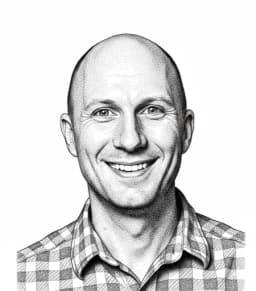
Matt Headley is a writer, builder, and former United Methodist pastor in northeast Alabama. He writes about farming, faith, business, and what all of them have in common at Southern Legends. The mark itself gets its own essay in What the Triskelion Means.




Responses